1. Introduction
Dataway lets Java applications publish APIs through configuration and connect to existing databases and services. Built on DataQL, it runs inside the application and provides a console for writing scripts, testing them and publishing HTTP endpoints.
DataQL handles queries, transformations and service aggregation. Dataway manages and publishes those scripts as APIs, reducing repetitive data-access and Controller code.
Development workflow
The application provides data sources, services and identities. Developers edit, test and publish scripts in the console; callers access published APIs over HTTP. Draft changes take effect after the API is published again.
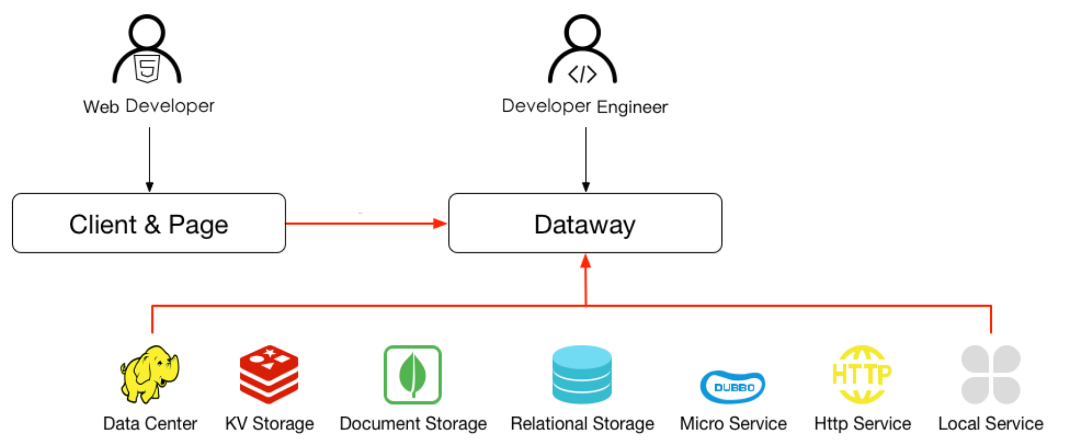
Use cases
| Scenario | Approach |
|---|---|
| Read data | Query reports, dashboards, lists and detail pages; select fields, calculate values and shape the output |
| Write data | Accept form or JSON parameters and invoke SQL or business services, with validation and transactions configured by the application |
| Aggregate data | Combine results from several databases or services into the structure needed by a single API call |
Embedded architecture
A shared core and adapters integrate with Spring, Solon and Hasor. The host supplies data sources, services and authentication.
| Component | Purpose |
|---|---|
dataway-embedded | API management, script execution, authorization and four HTTP handlers |
dataway-embedded-web | Console resource JAR, included by default and replaceable |
dataway-spring, dataway-solon, dataway-hasor | Host configuration and MVC integration |
dataway-meta-jdbc | Store API definitions, drafts and release history in a database |
dataway-meta-nacos | Store API definitions, drafts and release history in Nacos |
dataql-sqlproc | Optional SQL execution for application data |
Four HTTP entries share core services. Metadata and business data sources are configured independently; see request flow.
Start here
Follow Quick start to publish and call an API with Spring Boot and JDBC. The separate Spring Boot + Nacos example includes a test entry point that starts local Nacos automatically.
- Integrate Spring, Solon or Hasor.
- Prepare metadata storage and request identities.
- Write the script, then save and publish it through Visual operations.
- Enable Swagger / OpenAPI documents when needed.
This guide uses 5.0.1 with JDK 17. Examples use Spring Boot 4.1, Solon 4.1 and Hasor 5.3.